US-Iran Strikes: Stunning War Risk Looms


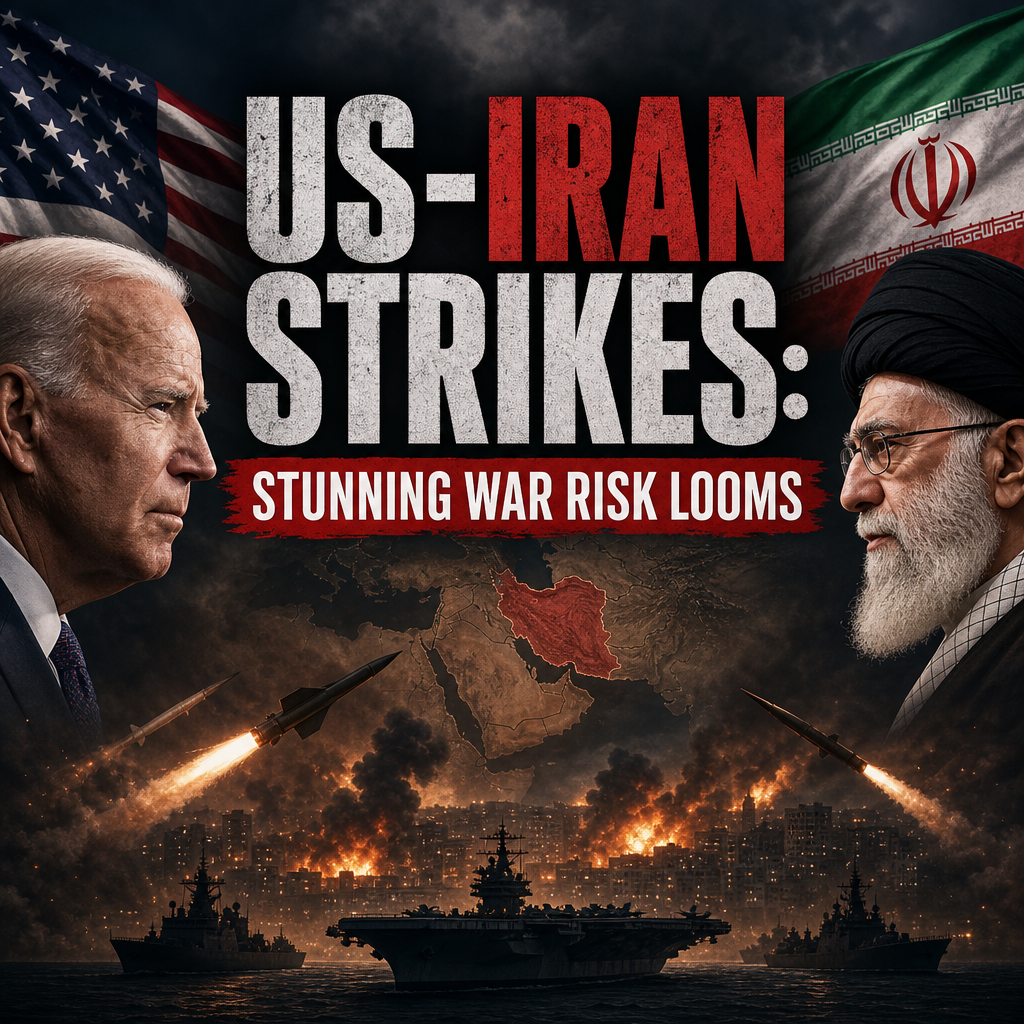
US-Iran strikes have pushed the Middle East into one of its most dangerous periods in years, and the biggest question now is not whether tensions are high, but how far the escalation can spread before diplomacy or deterrence slows it down.
The latest coverage across international outlets shows a common theme: even when leaders insist they want to avoid a wider war, military exchanges between the United States, Iran, and Iran-aligned forces create a fast-moving environment where miscalculation can turn a limited confrontation into something far larger. That risk is what makes this moment so unsettling. It is not simply about one strike or one retaliation; it is about how each move narrows the room for restraint.



Why US-Iran strikes are so dangerous
At the center of the crisis is a familiar but volatile pattern. One side says it is responding to aggression or defending allies, the other side frames the same action as provocation or an attempt to redraw the rules of force in the region. In that atmosphere, both Washington and Tehran face pressure not to appear weak. That can make de-escalation politically costly even when it is strategically wise.
Coverage from different outlets reflects different emphases, but there is broad agreement on the core danger: once direct strikes begin to involve major powers, the risk is no longer confined to the immediate targets. Instead, it spreads across shipping lanes, military bases, proxy groups, energy markets, and fragile diplomatic channels.




A few key factors make the situation especially perilous:
– Misreading intent: a strike intended as deterrence can be interpreted as preparation for a broader campaign.
– Proxy spillover: armed groups linked to Iran can act independently, widening the conflict without a direct order from Tehran.
– Regional exposure: countries hosting U.S. assets, or sitting near contested waterways, can be pulled in quickly.
– Political pressure: leaders on both sides may feel compelled to answer force with force.
That is why analysts often warn that the most dangerous stage of a confrontation is not the first strike, but the second and third rounds of retaliation.
How the media frames the crisis
RT’s reporting has tended to stress the possibility that U.S. military action could be seen as part of a broader pattern of Western intervention, with emphasis on the danger of escalation and the suspicion that Washington’s strategy may be self-defeating. In that framing, the key issue is whether American strikes are creating more instability than they resolve.
Al Jazeera’s coverage usually adds a different lens: the human and regional cost. That perspective tends to focus on civilians, cross-border fallout, and the way conflict reverberates through already fragile states. It also highlights how quickly diplomatic space can disappear when military exchanges dominate the agenda. From that point of view, the question is not just who has the upper hand, but who pays the price if the conflict widens.
Sky News, meanwhile, often approaches the issue through the lens of security, alliances, and strategic risk. Its reporting generally emphasizes the military balance, the role of U.S. forces in the region, and the possibility that even carefully measured strikes could trigger a chain reaction. That angle is less ideological and more operational: what happens if Iran retaliates against U.S. bases, or if allies are drawn into the response?
Taken together, these viewpoints do not cancel each other out. They reinforce a difficult truth: the crisis is simultaneously geopolitical, humanitarian, and military. Any serious assessment has to account for all three.
The real war risk is escalation, not just direct conflict
The phrase “stunning war risk” is not hyperbole if it means the situation is unstable enough to produce a wider conflict through accident or overreaction. Direct U.S.-Iran war remains a worst-case scenario, and neither side appears eager for an all-out confrontation. But that does not mean the danger is small.
The more likely pathway to a larger war would probably look like this:
1. A strike or attack hits a sensitive target.
2. The other side retaliates in a way meant to restore deterrence.
3. A proxy group, ally, or local force escalates further.
4. Domestic political pressure hardens positions.
5. Leaders lose control of the pace and scale of the conflict.
That sequence is exactly what makes the current situation so fragile. It is less about a single declaration of war and more about a series of actions that, piece by piece, make compromise harder.
What could still prevent a broader war?
Despite the danger, there are reasons not to assume the worst. Iran and the United States both understand the costs of direct war. A full-scale conflict would be expensive, unpredictable, and likely devastating across the region. That shared awareness has historically acted as a brake, even when rhetoric becomes severe.
There are also diplomatic off-ramps, though they are narrow. Backchannel messages, third-party mediation, and restrained military responses can all help lower the temperature. In past crises, indirect communication has often mattered more than public speeches. The challenge is that any de-escalation must satisfy multiple audiences at once: domestic voters, regional allies, military planners, and hardliners.
A cautious reading of the reporting suggests the following balanced conclusion: the risk of a major war is real, but not inevitable. Much depends on whether leaders treat strikes as isolated messages or as part of a longer campaign. If they choose the latter, the chance of a much wider conflict rises sharply.
For now, the most responsible view is one of guarded alarm. The region is not necessarily on the brink of total war, but it is close enough that a single misjudged response could push it over the edge. That is why the coming days matter so much. In crises like this, restraint is not weakness. It is often the only thing standing between a dangerous standoff and a catastrophe no one can easily control.